Key takeaways
VA means value addition: making charges plus wastage.
Always ask what VA includes, and add VA and making charges if both are shown.
A 4-point difference in VA can cost over ₹10,000 on a 20-gram chain.
GST on retail jewellery is 3% on the total value, including making charges.
VA is generally not recovered on resale, so compare it as carefully as the gold rate.
You are at the billing counter. The jeweller turns the screen toward you, and one line says “VA 12%”. You nod, because everyone else seems to understand it. Most people do not, and that single line can decide whether you pay ₹10,000 more or less for the same chain.
Here is what it means.
Quick answer: what is VA in a gold bill?
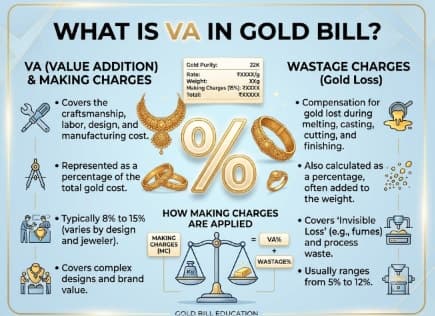
VA stands for value addition. It is the jeweller’s term for the extra cost added on top of the gold value, which mainly covers making charges and wastage. You may also see it written as V.A. or V.Addn. It is a trade term, not a government-defined charge, so the jeweller decides how to show it.
What is included in VA?
Making charges: the fee for labour, design, tools and finishing.
Wastage: the gold lost while the piece is made, such as filings, melting and polishing.
Other costs: some shops fold in hallmarking, packing or finishing costs.
In short: VA = making charges + wastage (+ small extras).
How is VA shown on a bill?
There are three common ways.
As a percentage of gold value. For example, “VA 10%”.
As a rate per gram. For example, “₹800 per gram”.
As a flat amount. More common on small items.
Is VA the same as making charges?
Not always. Some jewellers show one combined “VA” line. Others show making charges and wastage separately. If your bill shows both, add them together and treat the total as the real cost of making the piece. Customers on Reddit have complained about bills with VA charged on top of a line that shows 0% making,
which is why you should always ask what the VA contains.
How is VA calculated? A rupee example
For easy maths, assume 22K gold is ₹13,000 per gram, and you want a 20-gram chain.
Gold value: 20 × ₹13,000 = ₹2,60,000
VA at 10%: ₹26,000
Subtotal: ₹2,86,000
GST at 3%: ₹8,580
Total: ₹2,94,580
Now suppose a second jeweller quotes the same chain with VA at 14%.
VA at 14%: ₹36,400
Subtotal: ₹2,96,400
GST at 3%: ₹8,892
Total: ₹3,05,292
Four extra points of VA cost you ₹10,712 for an identical chain. This is why comparing the gold rate alone is not enough.
What is a fair VA?
It depends on the design. Zerodha’s gold pricing guide puts value addition (making plus wastage) at roughly 5% to 12%, plus 3% GST. As a general rule:
Plain machine-made chains and bangles sit toward the lower end.
Detailed temple, antique and handmade filigree work costs more because of the labour.
A very high VA on a simple, machine-made piece is worth questioning.
Prices differ between shops, so use these numbers as a guide, not a rule.
Gross weight, net weight and wastage on the bill
Look at the weights carefully.
Gross weight is the full weight of the piece, including stones.
Net weight is the gold weight after stones are deducted. Gold value should be calculated on this.
Some jewellers show wastage as extra grams on top of the net weight. If so, make sure you are not also paying a percentage VA for the same loss.
Weigh the piece on a scale in front of you if you have doubts.
What does GST apply to?
For jewellery sold to a customer, GST is 3% on the total value, and according to the GST clarification, that includes making charges, whether or not they are shown separately. So VA is taxed too. Some bills split it differently, so if you see a different rate on the making charge line, ask the jeweller to explain.
The exchange trap
If you exchange old jewellery for new, VA can hurt twice.
When you swap old gold for an equal weight of new gold, you generally pay VA and the related GST on the new piece, while the old gold is credited at its gold value. This is why exchanging the same family jewellery again and again costs you more every time. If you plan to exchange, ask for the exact credit rate and purity test result in writing.
Do you get VA back when you sell?
Usually not. A jeweller buying back your piece values it by weight and purity, so VA is generally not recovered. If you are buying jewellery for investment, lower VA matters more. If you are buying a piece to wear for decades, good craftsmanship may justify higher VA.
India bought 430.5 tonnes of gold jewellery in 2025, according to the World Gold Council. Even a small difference in VA, across that much jewellery, adds up to a lot of money.
Five questions to ask before you pay
What exactly does your VA include, making charges, wastage or both?
What is the VA percentage, and is it on gold value or per gram?
What is the net weight, and is wastage shown as extra grams?
Can you reduce the VA? It is often the most negotiable part of the bill.
What is the HUID number on each piece, and can I verify it in the BIS Care app?
Check the rate before you compare VA
A low VA with a high gold rate is not a good deal, so check both. See the gold rate in Mumbai or the gold rate in Delhi for city rates, the national gold rate today or, if you are near Boisar, the gold rate today in Boisar.
Frequently asked questions
What is VA in a gold bill?
VA stands for value addition. It covers the making charges and wastage that a jeweller adds on top of the gold value.
What is the full form of VA in gold?
Value Addition. It is also written as V.A. or V.Addn on some bills.
Is VA the same as making charges?
Not exactly. VA usually includes making charges and wastage together. If both are shown separately, add them for the real cost.
How much VA is normal on gold jewellery?
Zerodha’s pricing guide puts it at roughly 5% to 12% for typical jewellery. Intricate handmade pieces can cost more.
Can I negotiate VA?
Yes. VA is often the most flexible part of a jewellery bill. Compare at least two jewellers for the same design.
Is GST charged on VA?
Yes. GST on retail jewellery is 3% on the total value, which includes making charges.
Do I get VA back when I sell my gold?
Usually not. Buyers pay for the weight and purity of the gold, not the making cost.
What does VA mean in a silver bill?
It means the same thing: value addition, or the making charges and wastage added to the silver value.
Last updated: 31 October 2026. This guide is for general information only. Making charges, wastage and billing practices differ between jewellers, so confirm details with your jeweller before you buy.