Key takeaways
A bill is not required, but valid ID is.
Price depends on tested purity, the live rate, weight and a disclosed deduction.
Watch the test, get the quote in writing and take payment by bank transfer or UPI.
Tax applies to profit: 12.5% after 24 months, slab rate before.
The 500, 250 and 100 gram figures are seizure guidelines, not ownership limits.
Almost every home has that one box. A chain from a wedding, a bangle from a grandmother, a ring nobody remembers buying. The bill is long gone, and now you need cash and a nagging question: can I even sell this?
Good news: yes. Here is how to do it properly.
Can we sell gold without a bill?
Yes. No Indian law says you must show a purchase bill to sell your own gold. What buyers do need is proof of who you are. A reputable buyer will check your ID, test the gold, weigh it and keep a record of the sale. That record, not the original bill, is what protects both of you.
What you need to sell gold in India without a bill
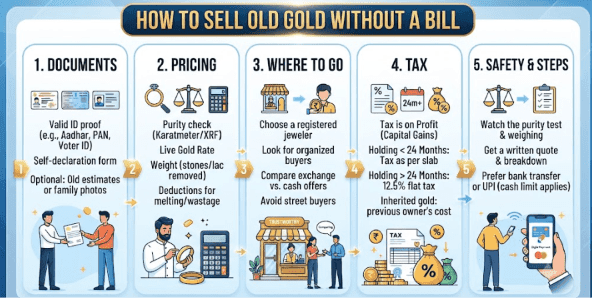
Two ID or address proofs, such as Aadhaar, PAN, passport, driving licence or voter ID
A PAN card for larger amounts (many buyers ask for it on higher-value sales)
A simple self-declaration that the gold is yours, if the buyer asks for it
Any old paper that helps, like a family photo, an old estimate or a will, though none of it is compulsory
How to sell gold in India without a bill: step by step
Check today’s rate first. Look at the live gold rate today before you speak to anyone. If you are in Maharashtra, check the gold rate in Mumbai. In the capital, check the gold rate in Delhi.
Take quotes from at least three buyers. Prices for the same piece can differ.
Watch the testing. Purity should be checked in front of you, with a karatmeter or XRF machine. Do not hand over your piece for testing out of sight.
Watch the weighing. Make sure the scale shows zero and that stones or lac are removed or noted.
Get the price in writing. It should show the rate, the weight, the tested purity and any deduction.
Take payment properly. Prefer a bank transfer or UPI. Some large buyers cap cash payments at ₹10,000.
Keep the receipt. It becomes your record, and the next owner’s “bill”.
How your price is decided when there is no bill
Your bill does not change the price. Four things do.
Purity. A piece marked 22K can test lower. Purity moves the price more than anything else.
The live rate. Gold moves through the day, so a rate quoted at 10 AM is not the rate at 8 PM.
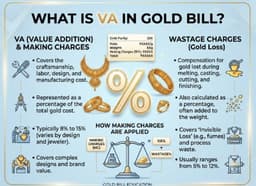
Melting or wastage deduction. Old jewellery has solder and other metals, so buyers deduct a percentage. Ask what it is and make sure it is written down.
Stones. Most buyers pay little or nothing for small stones, so expect them to be left out of the gold price.
A quick check: live rate × weight × purity, minus the disclosed deduction. If the buyer cannot explain their number this way, walk away.
Where to sell gold without a bill
A registered local jeweller. The best starting point if you have bought from them before.
An organised gold buyer. Companies that use XRF testing, show the process and give a printed quote are safer than informal dealers.
Exchange for new jewellery. Many jewellers will exchange old gold at its tested value. Compare this with the cash quote.
Avoid street buyers, anyone who offers “special cash rates” with no paperwork and anyone who refuses to test in front of you.
Selling gold without a bill in Mumbai. Compare quotes between an established jewellery market such as Zaveri Bazaar and a nearby organised buyer. Keep the live Mumbai rate open on your phone while you talk.
Selling gold without a bill in Pune. The same approach works. Visit more than one jeweller in markets like the Laxmi Road and Budhwar Peth area, or use an organised buyer, and ask for deductions in writing.
Selling a gold ring without a bill. A ring weighs little, so even small deductions change the price. Make sure the stone is weighed and valued separately from the gold, and ask for the exact weight of the gold part.
Is there tax when you sell gold without a bill?
There is no tax for having no bill. Tax applies to the profit you make.
Gold held for more than 24 months is a long-term asset, and the gain is taxed at 12.5% without indexation.
Gold held for 24 months or less is taxed at your income-tax slab rate.
For inherited or gifted gold, the previous owner’s cost and holding period usually carry over to you. That is why most family gold becomes long-term.
An individual selling personal gold does not charge GST. The buyer handles that on their side.
Example: Suppose you inherited 40 g of 22K bangles that your mother bought for about ₹30,000. For easy maths, assume gold is ₹13,000 per gram, so the sale value is ₹5,20,000. The gain is ₹4,90,000, and long-term tax at 12.5% is about ₹61,250. This is only an illustration. Without a bill, you may have to estimate the original cost, so speak to a chartered accountant.
What about the 500-gram rule?
Many people think they cannot own more than 500 grams of gold. That is not true. A CBDT instruction says that during an income-tax search, officers should not seize jewellery up to 500 g for a married woman, 250 g for an unmarried woman and 100 g for a man, even without proof. It is a seizure guideline, not a ceiling. If you hold more, be ready to explain where it came from, such as inheritance or gifts.
Why it pays to be careful now
Gold is a big part of Indian household savings, and old gold keeps coming back to the market. The World Gold Council recorded 21.7 tonnes of recycled gold in India in the October to December 2025 quarter, down 27% from a year earlier. At today’s prices, even a small gap in the buyer’s deduction can mean thousands of rupees.
Frequently asked questions
Can I sell gold without a bill?
Yes. No law requires a purchase bill. You need valid ID, and a reputable buyer will test the gold and record the sale.
How can I sell gold in India without a bill?
Compare quotes, watch the purity test and weighing, get the price and deductions in writing, and take payment by bank transfer or UPI.
Will I get a lower price without a bill?
Not with a trustworthy buyer. Price depends on tested purity, weight and the live rate. Unorganised buyers may offer less because they cannot verify the gold’s origin.
Where can I sell a gold ring without a bill?
A registered jeweller or an organised gold buyer. Ask them to weigh the gold and any stone separately.
Do I have to pay tax if I sell gold without a bill?
Tax is on the gain, not on the missing bill. Gold held for more than 24 months is taxed at 12.5% without indexation, and shorter holdings are taxed at your slab rate.
Can I sell inherited gold without a bill?
Yes. The previous owner’s cost and holding period usually carry over to you. Keep any family document that shows how you got the gold.
Last updated: 31 October 2026. This guide is for general information only and is not tax or legal advice. Confirm the rules and your own tax position with a chartered accountant.