Key takeaways
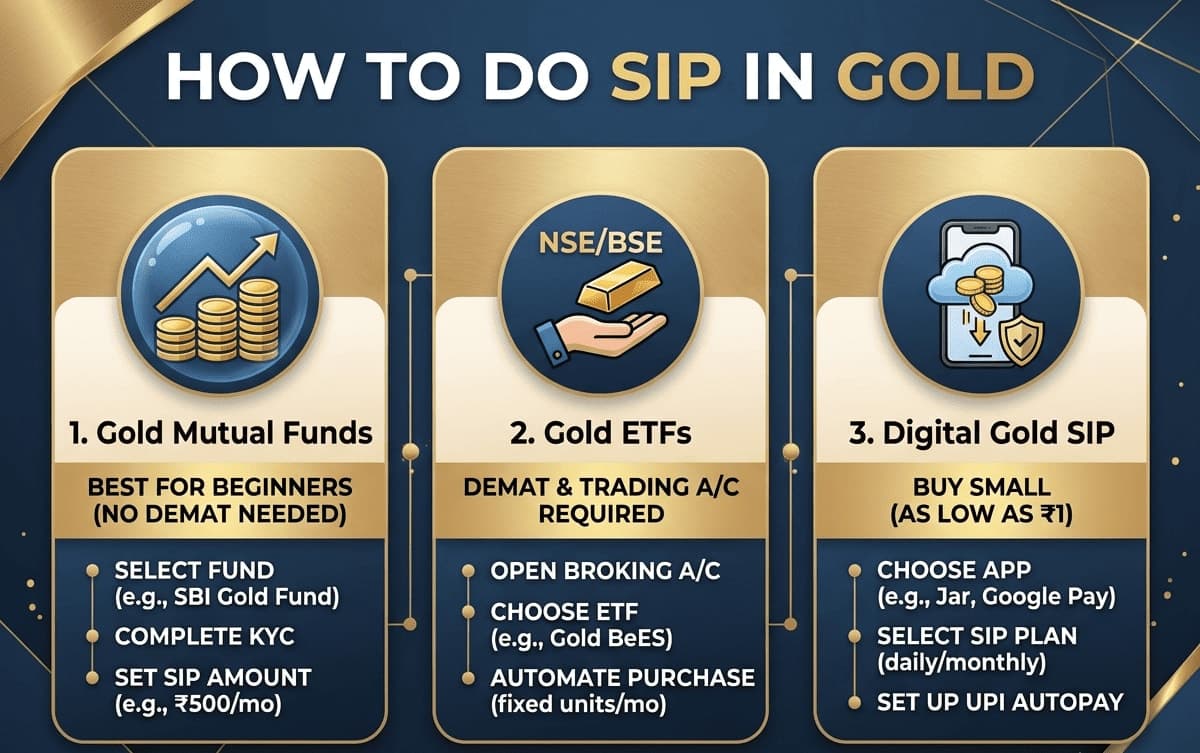
There are four ways to do SIP in gold: a gold fund, a gold ETF, digital gold or a jeweller’s scheme.
A gold fund is the simplest start, and digital gold has the highest cost and no SEBI protection.
Gold ETF gains turn long term after 12 months. Gold fund and digital gold gains take 24 months.
Each instalment has its own holding period.
A SIP averages your cost, but it does not guarantee a profit.
Gold fell about 26% from its January 2026 record high by late October. If you waited for the “perfect time” to buy, you are still waiting. This is exactly the situation a SIP is built for: small, regular purchases that remove the need to guess the bottom.
Here is how to do SIP in gold in India, and how to choose the route that fits you.
Quick answer: how to do SIP in gold
Pick a route, complete KYC, choose a monthly amount and set up an auto-debit. The four routes are a gold mutual fund (fund of funds), a gold ETF through a broker’s recurring plan, digital gold with auto-buy, or a jeweller’s monthly gold scheme. For most beginners, a gold fund is the simplest because it needs no demat account.
Four ways to do SIP in gold
1. Gold mutual fund (fund of funds)
The fund invests your money in gold ETFs. You can start a normal SIP through the fund house or an app, with a minimum that is often ₹100 to ₹500. No demat account is needed.
2. Gold ETF
Units trade on the stock exchange like shares and track the gold price. You need a demat and trading account. Fund-house SIPs are not available on ETFs, but several brokers offer recurring buys or you can place a monthly order yourself, with a minimum of one unit.
3. Digital gold
You buy 24K gold in tiny amounts through an app, which stores it in vaults. You can start with as little as ₹10 and set up a daily, weekly or monthly auto-buy.
4. Jeweller’s monthly scheme
You pay a fixed amount each month and redeem it for jewellery at the end. It is not an investment product. We explain this route in our guide to monthly gold schemes.
What each route really costs
Gold fund: you pay two layers of fees, the fund’s expense ratio and the expense ratio of the ETF it holds. Together they are usually well under 1% a year, but check the fund’s factsheet.
Gold ETF: a low expense ratio, plus brokerage and small taxes on each trade, and the ETF can trade slightly above or below the real gold value.
Digital gold: the most expensive per rupee. You pay 3% GST on each purchase, a buy-sell spread that analysts put at roughly 2% to 5% and sometimes a storage fee after a free period. On a ₹5,000 monthly SIP, GST alone takes about ₹146 each month.
Jeweller scheme: there is usually no interest, but you pay making charges and GST when you buy jewellery.
The safety point you should know
In November 2025, SEBI said digital gold is not a regulated security or commodity derivative, so SEBI’s investor protection does not cover it. It is not illegal, but you rely on the platform and its vault partner. Gold funds and gold ETFs sit under SEBI’s mutual fund rules.
Related Article: How to Check Hallmark on Gold
How a gold SIP works: a rupee example
Say you invest ₹5,000 a month for four months in a gold fund. The fund’s price (NAV) moves like this: ₹100, ₹80, ₹125, ₹100.
Month 1: ₹5,000 ÷ ₹100 = 50 units
Month 2: ₹5,000 ÷ ₹80 = 62.5 units
Month 3: ₹5,000 ÷ ₹125 = 40 units
Month 4: ₹5,000 ÷ ₹100 = 50 units
You invested ₹20,000 and hold 202.5 units. Your average cost is ₹98.77 per unit, while the simple average of the four prices is ₹101.25. You bought more units when the price was low. This is called rupee-cost averaging. It smooths your buying price, but it does not guarantee a profit if gold keeps falling. To understand the price swings behind this, read our piece on whether gold rates will decrease in the coming days.
How is a gold SIP taxed?
Tax depends on the route and how long you hold each unit.
Gold ETF: gains are long term after 12 months and taxed at 12.5% without indexation. Shorter gains are taxed at your slab rate.
Gold fund (fund of funds): gains are long term only after 24 months, taxed at 12.5%. Before that, they are taxed at your slab rate.
Digital gold: treated like physical gold, so long term after 24 months at 12.5%, and slab rate before that.
Each SIP instalment has its own clock. A unit bought in March is not long term just because the one bought last year is. For example, on ₹40,000 of gains, a 12.5% rate means ₹5,000 tax, while at a 30% slab it would be ₹12,000.
Related Article: What Is VA in a Gold Bill
How to start a gold fund SIP in five steps
Complete your KYC with PAN, Aadhaar and a bank account, on a fund house site or a mutual fund app.
Choose a gold fund. Compare the expense ratio, the fund size and how closely it tracks gold.
Pick an amount. Start with what you will not need for years, such as ₹500 or ₹1,000.
Choose the frequency. Monthly is the most common. Weekly also works.
Set up auto-debit through UPI or net banking and review it once or twice a year.
If you want digital gold instead, see our guide on where to buy gold online and compare charges before you pick an app.
Mistakes to avoid
Stopping your SIP when gold falls, which is when it buys the most units.
Choosing digital gold only because it starts at ₹10, without checking costs.
Putting too much of your money in gold. Many planners suggest keeping it as a modest share of your portfolio.
Ignoring the holding period and selling just before the long-term tax rate applies.
Expecting guaranteed returns. A gold SIP follows the gold price, minus costs.
Check today’s gold price before you plan. See the gold rate in Mumbai, the national gold rate today.
Frequently asked questions
How to do SIP in gold?
Choose a route (gold fund, gold ETF, digital gold or a jeweller’s scheme), complete KYC, pick a monthly amount and set up an auto-debit.
How to do SIP in gold ETF?
You need a demat and trading account. Fund-house SIPs are not offered on ETFs, so use a broker’s recurring-buy option if it has one, or place a monthly order yourself.
Is SIP in gold good?
It helps you buy gold regularly without timing the market, but it does not guarantee profit. Returns follow the gold price, minus costs.
What is the minimum amount for a gold SIP?
Digital gold can start at ₹10. Gold funds usually start at ₹100 to ₹500, and a gold ETF needs the price of one unit.
Which gold SIP is best?
It depends on your needs. A gold fund suits beginners without a demat account, a gold ETF suits investors who already use a broker, and digital gold is easiest but costs more.
Is digital gold safe?
SEBI said in November 2025 that digital gold is not regulated by it, so SEBI’s investor protection does not apply. Check the platform’s vault partner and charges.
How is a gold SIP taxed?
Gold ETF gains are long term after 12 months at 12.5%. Gold fund and digital gold gains need 24 months for that rate. Shorter gains are taxed at your slab rate.
Can I stop a gold SIP anytime?
Yes. You can pause or stop most SIPs without a penalty, though exit charges may apply on some products.
Last updated: 14 November 2026. This guide is for general information only and is not investment or tax advice. Mutual fund investments are subject to market risks, so read all scheme-related documents carefully and consult a qualified adviser.