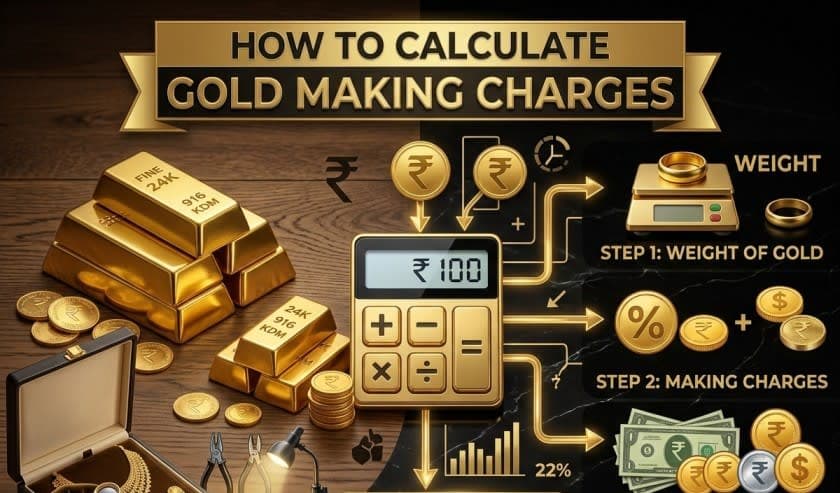
Key takeaways: How to Calculate Gold Making Charges
Making charge is calculated one of three ways: percentage, per gram or flat fee.
Always use net gold weight and today’s rate for your karat.
Convert every quote into a percentage of gold value so you can compare.
Add wastage and stone charges, then apply 3% GST on the total.
You can work backwards from any bill by dividing by 1.03 and subtracting the gold value.
You are shopping for a bangle. Jeweller A says “12% making”. Jeweller B says “₹1,400 per gram”. Jeweller C says “flat ₹30,000, no more questions”. All three sound reasonable, and all three are impossible to compare in your head.
Here is how to calculate gold making charges, so you can compare them without a headache.
Quick answer: how to calculate gold making charges
Gold value = net weight × today’s rate for your karat. Then use one of these:
Percentage method: making charge = percentage × gold value
Per-gram method: making charge = weight × rate per gram
Flat method: a fixed amount for the whole piece
Add wastage and stone value if they are charged, then add 3% GST on the total.
What are making charges?
Making charges are what the jeweller charges for design, labour, tools and finishing. They sit on top of the gold value. India bought 430.5 tonnes of gold jewellery in 2025, according to the World Gold Council, and each of those pieces carried a making charge.
Calculate the same bangle three ways
Take a 25-gram, 22K bangle. For easy maths, assume gold is ₹13,000 per gram. Replace this with today’s live rate when you calculate your own.
Gold value: 25 × ₹13,000 = ₹3,25,000
Method 1: Percentage of gold value (12%)
Making charge: 12% × ₹3,25,000 = ₹39,000
Subtotal: ₹3,64,000
GST at 3%: ₹10,920
Total: ₹3,74,920
Method 2: Per gram (₹1,400 per gram)
Making charge: 25 × ₹1,400 = ₹35,000
Subtotal: ₹3,60,000
GST at 3%: ₹10,800
Total: ₹3,70,800
Method 3: Flat fee (₹30,000)
Subtotal: ₹3,55,000
GST at 3%: ₹10,650
Total: ₹3,65,650
The same bangle costs ₹9,270 more at Jeweller A than at Jeweller C. Same gold, same design.
How to compare the three methods
Convert everything into a percentage of gold value.
Per gram: ₹1,400 ÷ ₹13,000 × 100 = 10.77%
Flat fee: ₹30,000 ÷ ₹3,25,000 × 100 = 9.23%
Percentage quote: 12%
Now you can see that the flat fee is the cheapest here and the percentage quote is the highest. Always use net gold weight, and make sure the quotes are for the same design and purity.
How to work out the making charge from a bill
Sometimes you only have the final amount. You can work backwards.
Say the bill total is ₹3,74,920 for 25 g of 22K gold at ₹13,000 per gram.
Remove the GST: ₹3,74,920 ÷ 1.03 = ₹3,64,000
Subtract the gold value: ₹3,64,000 − ₹3,25,000 = ₹39,000
Divide by the gold value: ₹39,000 ÷ ₹3,25,000 = 12%
If the result is much higher than the percentage on the quote, something else is hiding in the bill, such as wastage or stone charges.
Wastage and stones: do not forget them
Many bills add wastage on top of the making charge, or fold both into one “VA” line. Always add them together before comparing. Our explainer on what VA means in a gold bill shows how to read that line. Stones are priced separately and should not be counted in the gold weight, so check that you are being charged on the net gold weight.
Where GST fits in
GST for jewellery sold to a customer is 3% on the total value, including the making charge, not only on the gold. That is why GST goes in the last step of every calculation above. If you want the full rules, read our guide to GST on gold jewellery.
What happens when the gold price changes
This is where the methods behave differently. If gold rises from ₹13,000 to ₹14,000 per gram:
A 12% making charge rises from ₹39,000 to ₹42,000, because it moves with the gold value.
A ₹1,400 per gram charge stays at ₹35,000.
A flat ₹30,000 stays at ₹30,000.
So when prices are climbing, per-gram and flat fees protect you, and when prices are falling, percentage charges drop with them.
What is a normal making charge?
Jeweller guides commonly quote a range of about 5% to 25%. Plain, machine-made chains and bangles usually fall at the lower end, and detailed handmade or antique-style pieces at the higher end. The charge is not fixed by law, so it is open to negotiation, especially for heavier pieces and during festival offers. Some brands run “zero making charge” promotions, and it pays to know what is really being offered, which we cover in our piece on zero making charge gold rates.
Four-step check before you pay
Ask for the net gold weight, today’s rate and the making charge method in writing.
Convert each quote to a percentage of gold value.
Add wastage and any other charges to the making charge.
Check that GST is 3% on the total and that the bill adds up.
Keep today’s rate handy while you do this. See the gold rate in Mumbai or the gold rate in Delhi, the national gold rate today
Frequently asked questions
How do I calculate gold making charges?
Multiply the net gold weight by today’s rate to get the gold value. Then apply the jeweller’s method: a percentage of the gold value, a rate per gram or a fixed amount. Add GST at 3% on the total.
What is the formula for making charges on gold?
Percentage method: making charge = percentage × gold value. Per-gram method: making charge = weight × making charge per gram.
How do I calculate 22K gold making charges per gram?
Use the 22K rate for gold value, then multiply the weight by the per-gram making charge. To compare it with a percentage quote, divide the per-gram charge by the 22K gold rate per gram.
How can I find the making charge from a final bill?
Divide the total by 1.03 to remove GST, subtract the gold value, and divide the remainder by the gold value to get the percentage.
Is GST charged on making charges?
Yes. For jewellery sold to a customer, GST is 3% on the total value, including the making charge.
Which is better: percentage, per gram or flat making charge?
It depends on the quote. Convert all of them to a percentage of gold value. When gold prices are rising, per-gram and flat charges stay fixed, while percentage charges rise.
Can I negotiate making charges?
Yes. Making charges are not fixed by law. Compare at least two jewellers for the same design and ask for the charge to be itemised.
Last updated: 7 November 2026. The examples use an illustrative rate of ₹13,000 per gram. Making charges differ between jewellers, so confirm the exact terms before you buy.