Key takeaways
You can take gold on EMI, but jewellery is far easier to finance than coins or bars.
A ₹2,00,000 chain on a 12-month, 14% EMI costs about ₹17,900 extra.
GST on the jewellery is 3% on the total value, and 18% GST applies only to finance fees.
A monthly gold scheme avoids interest, while a gold loan is for borrowing against gold you own.
Always compare the total cost, not just the monthly instalment.
You have picked out a chain for a wedding. The bill is ₹2,00,000, your savings are not quite there, and the jeweller smiles and says, “Madam, EMI ho jayegi.” That sounds easy. But the monthly figure is never the full story.
Here is what you need to know before you say yes.
Quick answer: can we take gold on EMI?
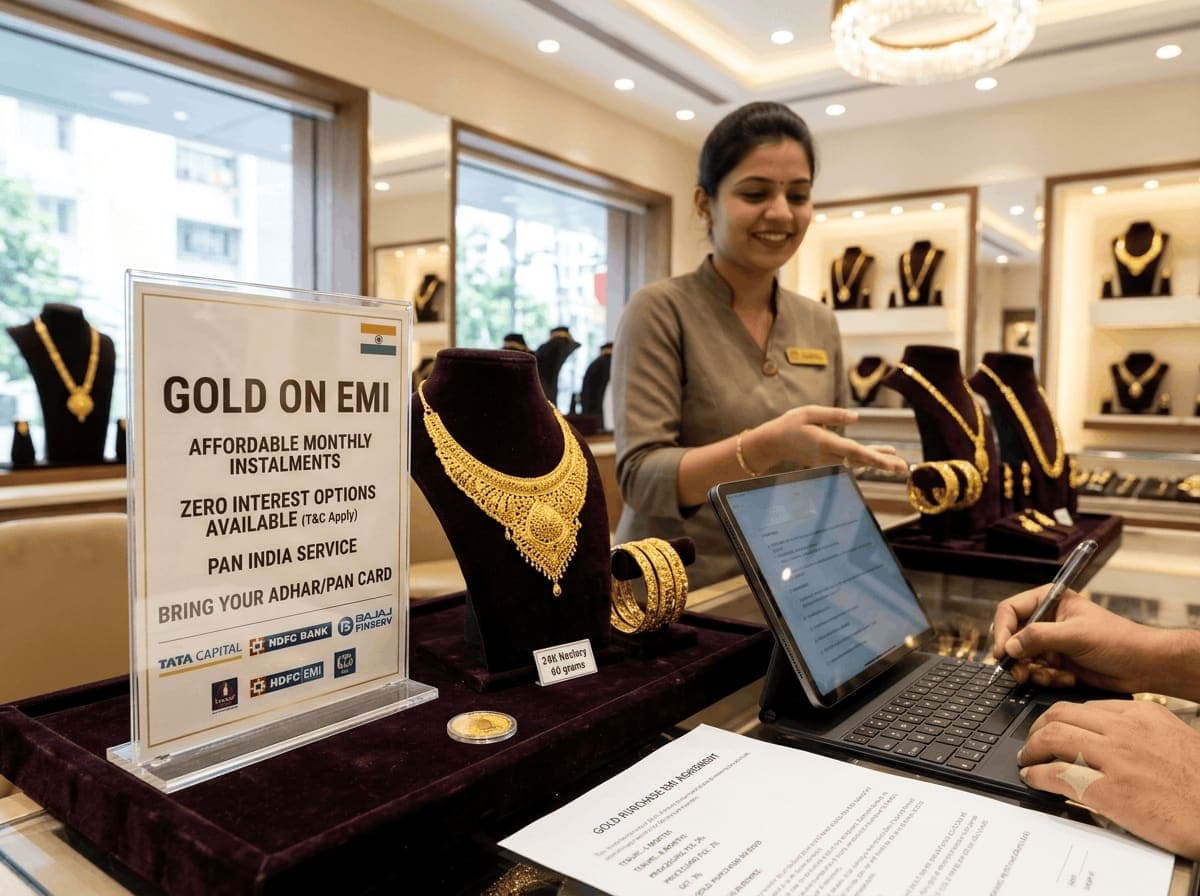
Yes. You can buy gold on EMI in India through a credit card, a debit card, an NBFC or consumer finance plan, a buy-now-pay-later app, or a jeweller’s own instalment plan. Jewellery is the easiest to get on EMI. Coins and bars are offered by fewer sellers. The catch is cost: most EMIs add interest, a processing fee and GST on that fee.
Five ways to take gold on EMI
Credit card EMI. You swipe the card at the shop and convert the amount into instalments, either at the counter or later through your bank.
Debit card EMI. Some banks allow eligible customers to convert debit card purchases into EMI.
NBFC or consumer finance. A finance company pays the jeweller and you repay it monthly, after a KYC and credit check.
Buy-now-pay-later. Some apps and online jewellery platforms offer short-term instalments at checkout.
The jeweller’s own plan. Some shops spread payment over several months, sometimes linked to a savings scheme.
Which of these is available depends on the shop, your bank and your credit profile, so ask for the exact terms in writing.
Can you buy gold coins or bars on EMI?
Sometimes, but it is harder. Many coin and bar sellers offer EMI only for 3 to 6 months, and mostly through credit card conversion.
There is also a regulatory reason. RBI directions from 2013 stop banks from lending money for buying gold, including coins and bullion. That is why a bank branch will not give you EMI on a gold coin. Whether a card issuer or finance company will convert a jewellery purchase depends on its own rules, so check before you assume.
What does gold on EMI really cost? A rupee example
Card and finance guides commonly quote EMI interest of about 13% to 18% a year, with a processing fee of around 1% to 2%. Let us use a middle case.
You buy a gold chain for ₹2,00,000 and pay over 12 months at 14% a year.
Monthly EMI: about ₹17,958
Total paid over 12 months: about ₹2,15,500
Interest: about ₹15,500
Processing fee at 1%: ₹2,000
GST at 18% on the fee: ₹360
Extra cost: about ₹17,900, which is roughly 9% on top of the chain’s price. That is more than a lot of people pay in making charges.
Is “no-cost EMI” really free?
Not always. A true no-cost EMI means the shop or the bank absorbs the interest. But sometimes the interest is built into the price, you pay a processing fee upfront, or the discount you would have got for paying in full disappears. Ask a simple question: “What will I pay in total if I pay in full today, and what will I pay on EMI?” If the two numbers differ, the EMI is not free.
What about GST?
GST on gold jewellery does not change because you pay in instalments. For retail jewellery, it is 3% on the total value, including the making charge. Some pages say 18% applies to making charges, which is not correct for jewellery sold to a customer.
The 18% GST applies to the finance side, such as processing and conversion fees. Our guide to GST on gold jewellery shows how the 3% is calculated.
Gold on EMI vs a gold scheme vs a gold loan
These three are often mixed up.
Gold on EMI. You take the gold home now and pay later, with interest and fees. You own the gold from day one, but you owe the money to a lender.
A monthly gold scheme. You pay a fixed amount each month, usually over 10 or 11 months, and use the total to buy jewellery at the end. Large chains run schemes like this, often with a making-charge benefit. It is not a loan, so there is usually no interest, but you get the gold later. Read the terms on rate locking, redemption and what happens if you stop paying. We explain the pros and cons in our guide to monthly gold schemes.
A gold loan. You pledge gold you already own and borrow against it. This is for raising cash, not for buying gold.
Is buying gold on EMI a good idea?
It can make sense when the purchase has a fixed date, such as a wedding, and a true no-cost offer is available, or when you can repay quickly. It is a poor idea when the interest is high, the tenure is long or you are borrowing to invest in gold. If gold falls after you buy, you still owe the full EMI.
A useful test: if the total extra cost is more than the making charge you would save by waiting, a gold scheme or saving first is usually the better deal.
Checklist before you sign
Ask for the total amount you will pay, not just the monthly EMI.
Get the interest rate, processing fee, GST and any foreclosure charge in writing.
Check the purity and the HUID using our guide on how to check hallmark on gold.
Confirm that the bill shows net weight, rate, making charge and GST separately.
Compare the price with the price for paying in full.
Check today’s rate before you decide. See the national gold rate today or, near Boisar, the gold rate today in Boisar.
Frequently asked questions
Can we take gold on EMI in India?
Yes. You can use a credit card, debit card, NBFC finance, a buy-now-pay-later plan or a jeweller’s instalment scheme. Availability and terms depend on the seller and your lender.
Can I buy gold coins on EMI?
Sometimes, usually for 3 to 6 months and mostly through credit card conversion. Banks are restricted from lending for gold purchases under RBI directions, so a bank branch will not offer EMI on coins.
Can I buy gold on EMI without a credit card?
Often yes, through debit card EMI, an NBFC, a buy-now-pay-later plan or a jeweller’s own plan, subject to eligibility checks.
Is there GST on gold bought on EMI?
Yes, the usual 3% GST on gold jewellery applies. The finance side also adds 18% GST on processing and similar fees.
Is no-cost EMI on gold really free?
Only if the seller or bank absorbs the interest and there is no hidden fee or lost discount. Compare the price on EMI with the price for paying in full.
Is a gold scheme better than gold on EMI?
A monthly gold scheme usually has no interest, but you get the gold at the end. EMI gives you the gold now, but costs more. The better option depends on how soon you need the jewellery.
What is the difference between gold on EMI and a gold loan?
With EMI you buy new gold and repay the lender. With a gold loan, you pledge gold you already own to borrow money.
Last updated: 8 November 2026. The EMI example uses an illustrative interest rate and fee. Rates, fees and eligibility differ between lenders and jewellers, so confirm every term in writing before you buy.