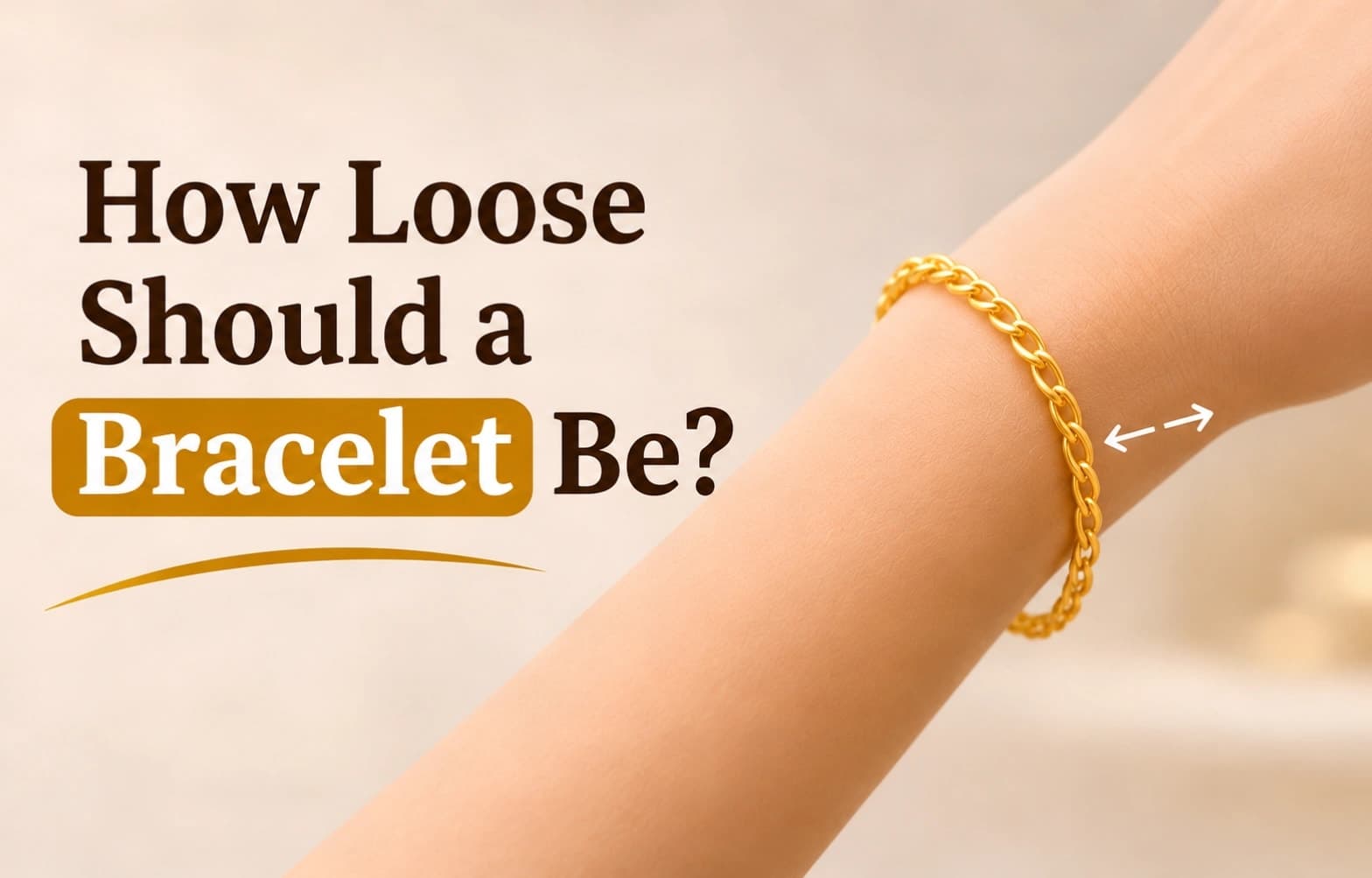
Quick answer: A bracelet should be loose enough to slide one finger between it and your wrist, but not so loose that it slips over your hand. For chain and tennis bracelets, that means a length about 0.5 to 1 inch (1.3–2.5 cm) more than your wrist measurement. Bangles and kadas are sized by your hand instead.
What is the one-finger rule for bracelet fit?
The one-finger rule is the simplest home check. Put the bracelet on and slide your index finger flat under it on the inside of your wrist. If the finger fits with light contact, the fit is right.
Two fingers fit easily: The bracelet is loose. It will spin, slide onto your hand and catch on things.
No finger fits: The bracelet is snug. It may leave marks, especially on hot days.
One finger, light contact: Comfortable everyday fit.
One finger of room equals roughly 0.5 inch extra for a thin chain and up to 1 inch for a thick link. Thick links need more because their bulk fills the inside space.
How much bigger than my wrist should a bracelet be?
Add 0.25 inch for a snug fit, 0.5 inch for a standard fit and up to 1 inch for a loose, draped fit. Most jewellers treat the half-inch "comfort" fit as the default for chain and tennis bracelets.
Fit | Add to wrist measurement | How it feels | Good for |
Snug | 0.25 in (about 0.6 cm) | Stays in place, barely moves | Thin chains, beaded strands, daily office wear |
Comfort (standard) | 0.5 in (about 1.3 cm) | One finger fits, moves a little | Most chain and tennis bracelets |
Loose / draped | 0.75–1 in (about 2–2.5 cm) | Slides towards the hand when arm hangs | Chunky links, charm bracelets, stacking |
What size bracelet do I need for my wrist?
Match your wrist measurement to the fit you prefer. Bracelets in India are mostly sold by length in inches (6.5, 7, 7.5 inches), so round to the nearest listed size.
Wrist measurement | Snug (+0.25 in) | Comfort (+0.5 in) | Loose (+1 in) |
5.5 in (14.0 cm) | 5.75 in (14.6 cm) | 6.0 in (15.2 cm) | 6.5 in (16.5 cm) |
6.0 in (15.2 cm) | 6.25 in (15.9 cm) | 6.5 in (16.5 cm) | 7.0 in (17.8 cm) |
6.5 in (16.5 cm) | 6.75 in (17.1 cm) | 7.0 in (17.8 cm) | 7.5 in (19.1 cm) |
7.0 in (17.8 cm) | 7.25 in (18.4 cm) | 7.5 in (19.1 cm) | 8.0 in (20.3 cm) |
7.5 in (19.1 cm) | 7.75 in (19.7 cm) | 8.0 in (20.3 cm) | 8.5 in (21.6 cm) |
8.0 in (20.3 cm) | 8.25 in (21.0 cm) | 8.5 in (21.6 cm) | 9.0 in (22.9 cm) |
8.5 in (21.6 cm) | 8.75 in (22.2 cm) | 9.0 in (22.9 cm) | 9.5 in (24.1 cm) |
Typical lengths are 6.5 to 7 inches for women and 7.5 to 8.5 inches for men. Your own wrist measurement always wins.
How do I measure my wrist with a string?
You need thread or a thin paper strip, a pen and a ruler, or a soft tailor's inch-tape.
Wrap the string around your wrist just above the wrist bone, where the bracelet will sit.
Keep it flat against the skin. Do not pull it tight.
Mark the point where the string overlaps itself.
Lay the string on a ruler and read the length to the nearest 1/8 inch or millimetre.
Repeat once, keep the larger reading and add your fit allowance.
Measure in the evening or after a walk. Wrists swell slightly with heat and activity, and Indian summers make a morning measurement run small.
How loose should each type of bracelet be?
Fit depends on how the bracelet goes on. Clasp bracelets are sized by wrist; closed bangles must pass over the hand, so they are sized by the hand.
Bracelet type | Ideal fit | How to size it |
Chain (rope, curb, figaro) | One finger of room; moves slightly | Wrist + 0.5 in; + 0.75–1 in for thick links |
Diamond tennis bracelet | Close but not tight; should not twist all day | Wrist + 0.25–0.5 in; size up slightly if between sizes because the stone line is stiff |
Bangle / kada (closed) | Slides over the hand with gentle pressure; moves freely on the wrist | By hand circumference at the knuckles, using the bangle chart below |
Hinged or openable bangle / kada | Sits close to the wrist; little vertical movement | By wrist measurement, as it opens to go on |
Cuff (open-ended) | Fitted; opening sits on the narrow side of the wrist | Inner size close to wrist measurement; roll on from the side, never prise open |
Charm bracelet | Loose enough for charms to hang freely | Wrist + 0.75–1 in, because charms take up inside space |
Beaded / stretch | Snug; should not dig in | Wrist + 0–0.5 in; beads larger than 8 mm need the upper end |
Watch-style link bracelet | Like a watch strap: slides 1–2 cm up the arm | Wrist + 0.5–0.75 in; adjust by removing links |
Men's chain or link bracelet | Slightly looser than women's; rests on the wrist bone | Wrist + 0.5–1 in; most finish at 7.5–8.5 in |
A loose tennis bracelet rotates, so the clasp shows on top and stones rub on desks. A tight one strains the clasp, its weakest point. For more on handling one, see [How to Open Diamond Tennis Bracelet].
What is the Indian bangle size chart?
Indian bangle sizes are written as inches plus sixteenths of an inch of inner diameter. So 2.4 means 2 and 4/16 inches (2.25 in), and 2.10 means 2 and 10/16 inches (2.625 in). That is why 2.10 comes after 2.8 and is larger, not smaller.
Bangle size | Inner diameter (mm) | Inner diameter (in) | Inner circumference (cm / in) |
2.2 | 54.0 | 2.125 | 16.9 cm / 6.7 in |
2.4 | 57.2 | 2.250 | 18.0 cm / 7.1 in |
2.6 | 60.3 | 2.375 | 18.9 cm / 7.5 in |
2.8 | 63.5 | 2.500 | 19.9 cm / 7.9 in |
2.10 | 66.7 | 2.625 | 20.9 cm / 8.2 in |
2.12 | 69.9 | 2.750 | 22.0 cm / 8.6 in |
2.14 | 73.0 | 2.875 | 22.9 cm / 9.0 in |
3.0 | 76.2 | 3.000 | 23.9 cm / 9.4 in |
Diameters follow BlueStone's 2026 chart; circumferences are rounded. CaratLane notes that men's kadas usually start around 2.8.
How to find your bangle size
From a bangle that fits: Lay it on a ruler and measure the inside diameter, edge to edge through the centre. Ignore the metal thickness.
From your hand: Bring your thumb towards your little finger, as if slipping on a bangle. Wrap a string around the widest part of the knuckles. Pick the size whose inner circumference matches or just exceeds that length.
Between sizes: For closed bangles, go one size up. For openable kadas, go down.
A correct bangle passes over the hand with gentle pressure and then hangs freely. It should not slide off when you shake your hand. For more styling, read [How to Wear Gold Bangles] and [How to Buy Gold Bangles].
How do I know if my bracelet is too tight?
A bracelet is too tight if any of these happen:
It leaves a red line or dent after an hour.
You cannot slide a finger under it.
The clasp is hard to close without help, or the links look stretched.
Your hand feels warm or tingles after long wear.
A bangle needs soap or oil to get on or off.
Tight bracelets also wear out faster because the clasp and links carry constant strain.
How do I know if my bracelet is too loose?
A bracelet is too loose if:
Two or more fingers fit under it easily.
It slides over the back of your hand when your arm hangs down.
The clasp keeps turning to the top of your wrist.
A bangle can slip off when you wash your hands.
It catches on cuffs, bag straps and laptop edges.
Loose bracelets are the ones most often lost.
How can I fix a bracelet that does not fit?
Most chain, link and tennis bracelets can be adjusted. Solid bangles are harder.
Problem | Fix | Who does it |
Chain or link bracelet too long | Remove links or shorten the chain and re-attach the clasp | Jeweller |
Chain bracelet too short | Add an extender chain or a few matching links | Jeweller |
Watch-style bracelet too loose | Remove a link with the pin tool | Jeweller or watch shop |
Tennis bracelet too long | Remove one or more stone links near the clasp | Jeweller (keep removed stones) |
Plain gold bangle slightly small | Stretch on a mandrel, usually by a small amount only | Jeweller |
Bangle slightly loose | Wear a clear silicone bangle guard inside, or stack a snug bangle | Yourself |
Cuff too loose or tight | Press gently on a cuff mandrel, not by hand | Jeweller |
Stone-set, enamel and hollow bangles often cannot be resized safely. See [How to Tighten Loose Bracelet].
Worked example: shortening an 18K gold chain bracelet
Say your 18K chain bracelet is 8 inches long and weighs 8 g, about 1 g per inch. Your wrist is 6.5 inches, so a 7-inch length gives a comfort fit.
• Gold removed: 1 inch, roughly 1 g.
• Value of that gold at ₹10,706/g (18K, India average, Groww, as of 26 Oct 2026): about ₹10,706.
• What to ask: whether the removed links will be returned to you or credited, and what the labour charge is.
City rates differ slightly, and jewellers add making charges plus 3% GST on new pieces. Always ask for removed gold back, or have it written on the job slip. To estimate what a whole piece is worth, see [How Much Is a 14k Gold Bracelet Worth?].
Should a bracelet sit above or below the wrist bone?
Most bracelets sit just above the wrist bone, towards the hand, where the wrist is narrowest. Measure there, and add the larger allowance if you like it resting on the bone.
If you wear one beside a watch, size it to rest against the case, not ride over it. For guidance on sides, read [Do Guys Wear Bracelets on the Left or Right?] and [Can You Wear Bracelets on Both Wrists?].
Frequently Asked Questions
How loose should a bracelet be?
It should leave room for one finger between the bracelet and your wrist. For chain and tennis bracelets, choose a length about 0.5 to 1 inch more than your wrist measurement. It should never slide over your hand.
What size bracelet fits a 6-inch wrist?
A 6.5-inch bracelet gives a standard comfort fit on a 6-inch wrist. Choose 6.25 inches for snug or 7 inches for a loose drape.
What is the most common bracelet size for women in India?
Bracelets of 6.5 to 7 inches fit most adult women. For bangles, 2.4 and 2.6 are among the most widely stocked sizes, but measure your hand to be sure.
What does bangle size 2.6 mean?
It means an inner diameter of 2 and 6/16 inches, which is 2.375 inches or about 60.3 mm. Its inner circumference is about 18.9 cm.
How loose should a tennis bracelet be?
A tennis bracelet should sit close with about a quarter to half an inch of extra length. If it constantly twists so the clasp shows on top, it is too loose.
Can a jeweller make a bracelet smaller?
Yes, chain, link and tennis bracelets can usually be shortened by removing links. Ask for the removed gold or stones back.
Should I measure my wrist in the morning or evening?
Measure in the evening, when heat and activity make your wrist slightly larger. A morning reading can feel tight later.