What Are Making Charges for Gold Jewellery?
Making charges (also called manufacturing charges or crafting fees) are what jewellers charge for converting raw gold into ornaments - covering artisan labour, design, tools, and overheads.
They are expressed in one of two ways:
• Percentage of gold value: e.g., 12% of ₹50,000 = ₹6,000
• Flat per-gram rate: e.g., ₹400/gram × 10 grams = ₹4,000
💡 Buyer Tip Branded jewellers use percentage-based charges - meaning as gold prices rise, so do their fees, even if the actual labour cost stays the same. Always compare both formats before buying. |
What Is the Average Making Charges Percentage in India?
Making charges vary by design type, jeweller, and city. Here is a general guide:
Jewellery Type | Making Charges | Notes |
Plain bangles / simple chains | 6%–12% | Most affordable |
Regular necklaces / sets | 12%–18% | Standard |
Intricate designs (filigree, temple, Kundan) | 18%–30%+ | High craftsmanship |
Machine-made / mass-produced | 5%–8% | Flat per-gram common |
Branded (Tanishq, Malabar, etc.) | 14%–25% | Includes brand premium |
As a buyer, you always have the right to ask for a full breakdown of making charges before purchasing. Transparent jewellers will provide this freely.
Track the live gold price per gram in India to quickly calculate the base value and verify if the quoted total is fair.
What Is Wastage in Gold Jewellery?
Wastage is an additional charge some jewellers add on top of making charges. In theory, it represents the small amount of gold lost during crafting - filings, spills, or offcuts.
• Typical wastage range: 0%–5%
• In practice, jewellers recycle most gold scraps, so actual wastage is minimal
• Some jewellers fold wastage into making charges; others list it separately
💡 Buyer Tip Always ask whether wastage is included in the making charges or listed separately. The answer significantly affects your final price. |
What Is VA (Value Addition) in Gold Jewellery?
VA or Value Addition is a premium added for design, branding, finish quality, and aesthetics - beyond just gold and labour costs.
• VA charges can range from 5% to 50%+ in designer or luxury jewellery
• A branded piece (e.g., Tanishq) carries higher VA than a local jeweller's equivalent-weight piece
• VA charges are NOT recoverable at resale - buyers pay only raw gold value
Making Charges in Dubai vs India - What's the Difference?
Dubai is a popular gold-buying destination for Indians, largely because making charges are significantly lower.
Location | Average Making Charges | Charging Method |
India | 12%–20% (standard) | Percentage-based |
Dubai | 5%–10% (standard) | Flat per-gram (common) |
Dubai's lower charges are driven by flat per-gram fee structures, no income tax, and lower business overheads - savings that are partially passed on to buyers.
Compare live prices: todays gold rate in Saudi vs Indian gold rates.
How Is Gold Jewellery Price Calculated? (Step-by-Step Formula)
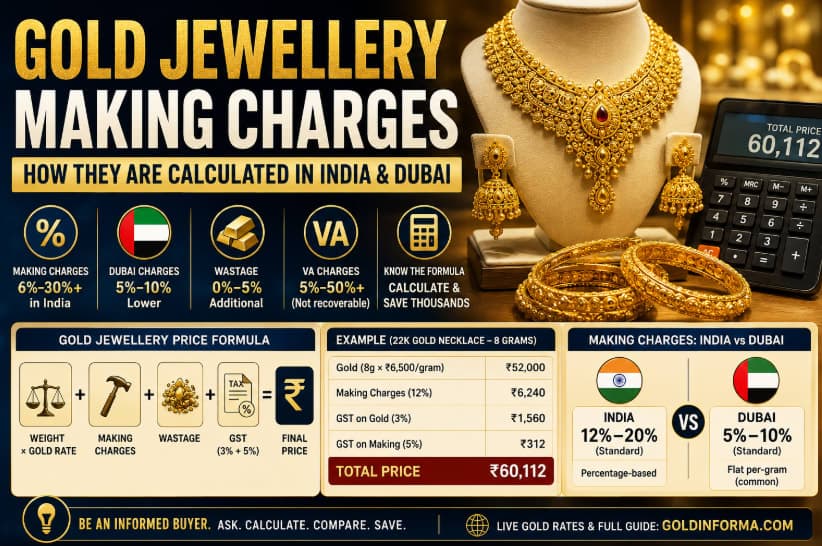
Formula: Final Price = (Weight × Gold Rate) + Making Charges + Wastage + GST |
Worked Example (22K Gold Necklace - 8 Grams)
Component | Amount |
Gold (8g × ₹6,500/gram) | ₹52,000 |
Making Charges (12%) | ₹6,240 |
GST on Gold (3%) | ₹1,560 |
GST on Making (5%) | ₹312 |
Total Price | ₹60,112 |
Making Charges Checklist - How to Verify Before You Buy
Use this quick mental check at any jewellery store:
• Ask for the weight in grams
• Look up the live gold rate for that karat (22K or 18K)
• Multiply weight × rate = raw gold value
• Ask for making charges as a percentage or per-gram rate
• Add 3% GST on gold + 5% GST on making charges
• Compare with the quoted price - any gap should be explained as wastage, VA, or stone cost
💡 Buyer Tip If the quoted price is significantly higher than your calculation, ask the jeweller to itemise the difference. A reputable jeweller will always explain it. |
Calculating Making Charges on Gold Jewellery
The charging system for making gold jewellery may vary. Some goldsmiths will charge you per gram, while others will charge you a percentage of the gold value, or a lump sum.
Main Methods to Determine Making Charges
1) Per Gram Method
In this method, the goldsmiths charge you a predetermined price for each gram of gold.
Making Charges Formula
Making Charges = Weight of Gold (g) × Making Charge per Gram
Example
If 10 grams of gold is used to make a ring and each gram costs ₹ 400, then
Making Charges = 10 × ₹ 400 = ₹ 4,000
2) Percentage Method
In this method, the gold making charges will be of the order of a particular percentage of the gold value. This will be determined by the goldsmith and the intricacy of the jewellery.
Making Charges Formula
Making Charges = Gold Value × (Making Charge % ÷ 100)
Example
Let the gold value be ₹ 60,000 and a making charge of 10% is applicable.
Then
Making Charges = ₹ 60,000 × 10% = ₹ 6,000
3) Fixed Making Charges
Some goldsmiths may charge a fixed making fee. This amount will not be affected by the gold used.
How Do You Determine The Final Price of Gold Jewellery?
The final price of gold jewellery will include the value of gold itself, the making charge, and the GST applicable on the amount.
Formula
Final Price = (Gold Rate per Gram × Gold Weight) + Making Charges + GST
For instance, if the gold value is ₹60,000 and the making charge is ₹6,000, GST then is calculated and the amount payable is finalized.
For example, final price calculation is as follows: Gold Value : ₹60,000, Gold Weight: 600 g, Gold Rate per Gram: ₹600, Making Charge: ₹6,000, GST: Nil. Therefore final amount to be paid would be ₹66,000.
Frequently Asked Questions
What is the average making charges for gold jewellery in India?
Typically 8%–20% depending on design, jeweller, and city. Simple machine-made jewellery may be as low as 5%–8%, while handcrafted or designer pieces can reach 25%+.
Can making charges be negotiated?
Yes - especially at non-branded or local jewellers. Making charges are not regulated by law and are set at the jeweller's discretion. It is perfectly acceptable to negotiate.
What is wastage in gold jewellery?
A charge representing gold theoretically lost during manufacturing. In practice, most jewellers recycle gold scraps, so it often functions as an additional margin. Typically 0%–5%.
Why are making charges not refunded when selling gold?
Because making charges represent craftsmanship cost, not gold value. When selling, buyers pay only for the gold content at that day's market rate - the labour component is not recovered.
Are making charges the same for all jewellery types?
No. Plain bangles and chains attract 6%–12%, while filigree, temple jewellery, or designer pieces can attract 20%–35% or more.
How to Calculate Gold Rate in India?
Gold rate in India is calculated by converting international gold price (USD/ounce) to INR/gram, then adding import duties, taxes, and dealer margins. Use formulas like 22K = 24K × (22/24) to adjust for purity.
What Is the Current GST Rate on Gold Jewellery in India?
As of 2025, GST on gold jewellery in India follows a dual-rate structure:
· 3% GST on the value of the gold content (the commodity itself)
· 5% GST on making charges (the artisanal labour component)
Why Is Gold Used for Making Jewellery?
Gold is used for making jewellery because it is the ideal metal for jewellery because of its malleability, non-reactive nature, durability and lustrous appeal. Understand 22K vs 24K and why platinum and silver are also used.
Why Is 24 Carat Gold Not Used for Making Jewellery?
24K gold is too soft for everyday jewellery. Its extreme malleability causes it to scratch, bend, and lose shape with regular wear. Jewellers use 22K or 18K gold instead - alloyed with other metals for durability, hence 24 carat gold is not used for making jewellery