Key takeaways
Mild soap, warm water, a baby toothbrush and a soft cloth handle most plain gold jewellery.
Never soak kundan, polki, lac-filled, pearl or gold-plated pieces.
Avoid toothpaste, baking soda, vinegar, lemon, bleach and chlorine.
Clean daily-wear pieces every two weeks and deep-clean monthly.
Cleaning does not change value. Weight, purity and the day’s rate do.
You open the almirah the night before a wedding and your daily-wear 22K chain looks tired. It is not black, not damaged, just flat and slightly greasy, like it has been through a hundred Mumbai monsoon commutes. Good news: that is almost always dirt and body oil, not damaged gold, and you can fix it at home with things already in your kitchen.
This guide explains how to clean gold jewelry at home safely, piece by piece, including the Indian jewellery types most guides skip: kundan, polki, meenakari, lac-filled bangles and mangalsutras.
Quick answer: how to clean gold jewelry at home
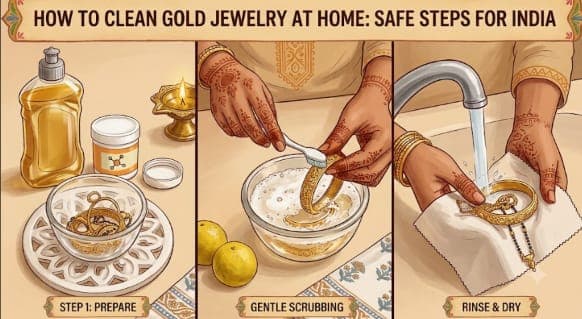
Put a few drops of mild dish soap in a bowl of comfortably warm water, soak plain gold for 15 to 20 minutes, brush gently with a baby toothbrush, rinse in a bowl (not under a running tap), and pat dry with a soft cotton cloth. Do not soak stone-set, kundan, polki, pearl, lac-filled or gold-plated pieces. Wipe those with a barely damp soft cloth instead.
First, check what you are actually cleaning
The right method depends on the piece, so take 30 seconds to sort your jewellery into these groups.
Plain solid gold (chains, plain bangles, rings, coins, studs): safe for the soak method below.
Gold with hard stones (diamond, ruby, sapphire): no long soak, brush-clean only.
Soft or porous materials (pearls, coral, emerald, opal, lac or lakh filling, kundan and polki foiling): no soaking, no brushing of the stones.
Gold-plated, gold-filled or vermeil (imitation and fashion jewellery): no soaking, no scrubbing. The gold layer is thin and wears away.
Not sure whether a piece is solid gold? Look for the BIS hallmark. Since 1 April 2023, hallmarked gold jewellery sold in India carries a 6-character alphanumeric HUID (Hallmark Unique Identification) code along with the purity mark, such as 916 for 22K. If an older piece has no hallmark, treat it gently until your jeweller has checked it.
Why gold jewellery looks dull in the first place
Pure 24K gold (999 purity, 99.9% gold) is very soft and does not tarnish. Jewellery is made harder by mixing in other metals, so 22K is 91.6% gold, 18K is 75% and 14K is about 58.3%. Gold itself does not react with air, but the copper, silver or zinc in the alloy can darken slightly with sweat and humidity.
In practice, though, most dullness comes from a film of body oil, sunscreen, talc, perfume, hair oil, soap residue and dust sitting in the grooves. That film is why a clean piece suddenly looks twice as bright. In humid cities like Mumbai and Navi Mumbai, sweat and coastal moisture speed this up.
What you need
A small steel or glass bowl
Mild liquid dish soap or baby shampoo (no bleach, no lemon-based cleaners)
Comfortably warm water, roughly 40°C. It should feel pleasant on your wrist, never hot
A baby toothbrush or very soft makeup brush
A soft, lint-free cotton or microfiber cloth
Optional: a wooden toothpick for tight corners
Step-by-step: clean plain gold jewelry at home
Mix the solution. Fill the bowl with warm water and add 3 to 4 drops of mild dish soap. Swirl until it looks slightly cloudy.
Soak for 15 to 20 minutes. This loosens oil and dust. There is no benefit in soaking for hours.
Brush gently. Use the baby toothbrush in small circles, especially around clasps, links and engraved patterns. Two minutes per piece is plenty. Gold is soft, so pressure does more harm than good.
Rinse in a bowl. Dip the piece in a second bowl of clean lukewarm water. Do not rinse over an open sink. If you must, close the drain first. Rings and earring backs vanish down drains in seconds.
Dry properly. Pat dry with the cloth, then leave on a dry towel for 10 minutes. Trapped moisture in chain links is what causes that dull, spotty look later.
Buff lightly. A few light strokes with a dry microfiber cloth bring back the shine. Do not use tissue paper or rough kitchen towels, as they leave fine scratches.
This works on yellow, rose and white gold.
How to clean specific pieces
Gold chains. Chains hold the most grime between links. After the soak, run the chain through a folded soft cloth while holding one end, then brush link by link. For a knot, put a drop of baby oil on it and ease the knot apart with two pins before washing.
Bangles and kadas. Plain bangles follow the standard method. Bangles with lac (lakh) filling, enamel or stones must stay out of water. Wipe the metal with a damp cloth, then dry immediately.
Mangalsutra. Clean the gold pendant and chain carefully, but keep the black glass or onyx beads and thread dry. Wipe beads with a dry cloth. If the thread is old, get it restrung rather than washing it.
Earrings and jhumkas. Wash the hooks and posts well, as they touch skin and collect the most oil. Hollow or lac-filled jhumkas should not be soaked, because water gets trapped inside and cannot be dried out properly.
Rings. Soak, then brush under the stone setting and along the inside of the band, where soap and lotion collect.
How to clean gold jewelry with stones
Diamond, ruby and sapphire are hard, but their settings are not water-friendly for long. Soaking can loosen glue in some settings and trap soap behind stones, making them look cloudy.
Check that no stone is loose before you start. If a stone moves when you tap the piece gently near your ear, skip cleaning and see a jeweller.
Dip a baby toothbrush in the soapy solution and brush the gold and the stone edges. Do not leave the piece sitting in the bowl.
Rinse briefly in a bowl of clean water and dry fully.
Avoid water completely for pearls, coral, opal, emerald and turquoise. Wipe with a dry, soft cloth.
How to clean kundan, polki, meenakari and temple jewellery
These traditional pieces are gold combined with materials that do not like water: lac backing, foil under the stones, enamel and natural stones. Water gets under the foil and permanently clouds it.
Use a dry, soft brush (a clean makeup brush works) to dust out the grooves.
Wipe the metal with a barely damp cotton bud. Keep it off the stones and enamel.
Dry at once with a soft cloth.
For deep dirt, take it to a jeweller who works with traditional pieces. Do not experiment on bridal sets or heirlooms.
How to clean gold-plated jewellery
Gold plating is a very thin layer over another metal. Soaking, brushing and any cleaner will wear it off. Wipe gently with a barely damp soft cloth, dry immediately and store it away from perfume and sweat. When the colour fades, it needs re-plating, not cleaning.
Home remedies: what works and what damages gold
People search for all of these, so here is the honest answer for each.
Dish soap and warm water: works. Safe, cheap and what jewellers recommend for plain gold.
Toothpaste: avoid. It feels like it is working because it scrubs, but toothpaste is abrasive. Over time it leaves fine scratches that make gold look duller, and it gets stuck in engravings.
Baking soda paste: avoid for regular use. Same problem. It is a mild abrasive, and it can harm soft stones and leave a residue in design work.
White vinegar or lemon juice: avoid. Acids can attack the solder joints that hold chains and settings together, and they can damage many gemstones. They also do not remove oil as well as soap does.
Turmeric (haldi): does not clean gold. It is a dye and can stain porous materials, lac and thread. It has a place in puja, but not in jewellery care.
Salt, tamarind and ash: avoid. These are traditional for brass and silver utensils. On gold jewellery, the grit scratches and the acid from tamarind affects the alloy.
Bleach, chlorine and ammonia: never. Chlorine from swimming pools, bleach and strong household cleaners can discolour the alloy and weaken solder joints.
Club soda or sparkling water: optional. A short soak in sodium-free soda water can loosen dirt, but plain soap and water does the same job.
How often should you clean gold jewellery?
Daily-wear chains, rings, studs and mangalsutra: a quick soap wash every two weeks, and a full soak once a month. In humid or coastal areas, do it more often if the piece feels sticky.
Occasional pieces: clean twice a year, and always before long storage.
Festive and bridal sets: a gentle dry wipe after every wear. A professional check once a year, ideally in the weeks before Dhanteras, Diwali or the wedding season, gives you time to fix loose stones or weak clasps.
When to take it to a jeweller
Home cleaning has limits. See a jeweller if:
The piece is still dark after two cleanings.
Stones are loose, cloudy or discoloured.
A chain has weak links or the clasp does not hold.
You are cleaning heirloom, kundan or polki jewellery.
Jewellers use ultrasonic, steam or ionic cleaners and can tell whether your piece can take them. Ultrasonic cleaning can loosen certain stones, so it should not be used on every piece.
One tip most blogs miss: if you ask for professional buffing or polishing, the jeweller removes a tiny layer of metal. It is usually small, but on a heavy bangle it can add up. Ask them to weigh your piece before and after, and note the weight on your bill.
Does cleaning change the value of your gold?
No. The value of your jewellery depends on weight, purity and the day’s rate, not on how shiny it looks. A dull chain and a shiny one of the same weight and karat are worth the same on the same day. If you are planning to sell or exchange, you do not need to polish anything first. A jeweller will test purity regardless.
What does help is tracking the rate. See today’s price in your city: gold rate in Mumbai, gold rate in Delhi, or the national gold rate today. If you are near Boisar, check the gold rate today in Boisar before you buy, sell or exchange.
Daily habits that keep gold shining longer
Wear jewellery last: apply perfume, hairspray, sunscreen and makeup first, then put your gold on.
Remove it before swimming, cooking with strong spices or oil, workouts, cleaning and bathing.
Wipe with a soft cloth after each wear. It takes ten seconds and prevents most buildup.
Store each piece separately in a soft pouch or compartment so pieces do not scratch each other. Keep a silica gel packet in the box if you live somewhere humid.
Keep gold away from silver in storage. Silver tarnishes and can leave marks.
Mistakes that ruin gold jewellery
Using hot water on pieces with stones or lac.
Rinsing directly over an open drain.
Scrubbing hard with a stiff brush.
Drying with tissue paper or rough towels.
Trying chemical cleaners from the internet on bridal sets.
Storing damp jewellery.
Frequently asked questions
Can I clean gold jewelry at home with just water and soap?
Yes. Mild dish soap in warm water is the safest method for plain gold. Soak 15 to 20 minutes, brush gently, rinse in a bowl and dry fully.
How do I make gold shiny again?
Usually it is dirt, not damage. Clean it with soap and warm water, then buff with a dry microfiber cloth. If it is still dull after two cleanings, it may need professional polishing, or the piece may be gold-plated and worn.
Is toothpaste safe for cleaning gold?
No. Toothpaste is abrasive and can leave fine scratches, especially on high-polish and engraved pieces. Use soap and a soft brush.
Does vinegar clean gold?
It can remove some tarnish, but acids can damage solder joints and many gemstones. Soap and water is safer and works just as well for everyday dirt.
Can I use baking soda on gold?
It is better avoided. Baking soda is a mild abrasive and can leave residue or marks, especially on fine design work.
How do I clean a gold chain at home?
Soak it in warm soapy water for 15 to 20 minutes, brush link by link, rinse in a bowl and dry completely. Untangle knots before washing, with a drop of baby oil and two pins.
Can I clean gold jewelry with stones at home?
Yes, but do not soak it. Brush the gold and stone edges with a baby toothbrush dipped in soapy water, rinse quickly and dry well. Avoid water for pearls, coral, emerald and opal.
How often should I clean gold jewelry?
Every two weeks for a quick wash and monthly for a deeper clean if you wear it daily. Clean occasional pieces twice a year.
Does cleaning gold reduce its weight?
Home washing does not. Professional buffing can remove a very small amount of metal, so ask for the weight before and after.
Does cleaning gold jewelry change its value?
No. Value depends on weight, purity (karat and hallmark) and the day’s gold rate, not on shine.
Last updated: 22 October 2026. This guide is for general care. For heirloom, antique or high-value pieces, check with a trusted BIS-hallmarked jeweller.