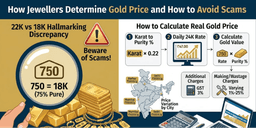
Jain takes a ring that is advertised as “24KT motichoor ka challa” and tests it with a spectrometer.
Spectrometer tests show that the ring contains only ∼96% gold and should contain at least 99.5% to be considered 24K gold.
What that means is that you are paying for 99.5% gold but are only getting 96% gold.
The real financial loss
Jain shows what the impact is on a 10 gram purchase. At the current 24K rate, that difference in purity costs the buyer ₹8,000.
What genuine 24K gold should look like
He tests a piece that is properly hallmarked with BIS Hallmark + HUID (Hallmarking Unique ID). That sample also tests at 99.5% purity.
How to protect yourself
Make sure the jewelry has BIS Hallmark + HUID: Every piece of legal gold jewelry in India should have this. HUID allows you to trace the purity and certification.
Verify with the BIS Care App: Scan the HUID on the BIS Care app to check if the purity and validation before paying.
Don't chase low making charges: Jain says that the making charge can be as low as you want, but if the gold isn't pure, it isn't worth wearing.
More Context
The creator clarifies this isn't about framing all jewellers, 99% are honest. However, there is that 1% where purity isn't up to mark, and as a buyer, being informed is the best protection.
The truth is, you need to ask to see the BIS hallmark and HUID, and verify it on the BIS Care app before you buy. Only then can you be sure you aren't overpaying for 96% gold.